

K4BL IS HERE!!!!!!
K4BL IS HERE!!!!!!

Our public beta is LIVE!!!!
Learn More About Keywords for Black Louisiana
-
Keywords for Black Louisiana (K4BL) is a collective of researchers creating digital projects highlighting the Black life and culture of the Gulf Coast. With the support of funding from the National Historic Publications and Records Commission, K4BL is building a community-engaged digital edition of annotated, transcribed and translated manuscript documents from 18th century (French and Spanish) Louisiana. The stories in these documents describe the lives and resistance of enslaved and free Africans and people of African descent against bondage, colonialism, and the everyday terror of slavery. Access to the stories of Black life in these documents has been limited to those trained in paleography or with French and/or Spanish translation skills. Providing access to the stories in these documents through English language translations and digital access does more than offer researchers, teachers, public historians, and artists opportunities to learn from the centuries-long Black freedom struggle Gulf Coast communities have been engaged in. It also creates a tremendous resource for African descended communities in Louisiana whose ancestors fueled some of the most important moments in American history.
K4BL centers African descended Gulf Coast communities and accountability to Black humanity at every level of the project, from the annual Black History Summer Workshop for Black public historians in Louisiana, to our collaborations with team members at Louisiana historically black colleges and universities, to our intergenerational and decentralized leadership structure, to our commitment to Black Digital Humanities (DH) principles.
We hope K4BL can provide a model for community-engaged digital recovery and preservation that will be remixed and reused by digital historians, computational humanists, data scientists, and digital humanities practitioners broadly who are looking for ethical and humane ways to center the needs of Black communities and institutions on the ground in the work of creating and curating digital materials.
-
Beginning in 2020 as part of LifexCode: Digital Humanities Against Enclosure (lifexcode.org), and most recently through funding from a National Historic Publications and Records Commission grant, we have embarked on research in Gulf Coast Louisiana’s archive, seeking to expand our historical practice and learn from what eighteenth-century Gulf Coast Louisiana has to teach us.
In 2022, K4BL was awarded a NHPRC-Mellon Planning Grant for Collaborative Digital Editions. One of the goals of the planning period was to more accurately assess the pace of work and the capacity of the team as constituted to identify documents, create metadata, as well as initiate and complete transcriptions and translations. During the planning grant period K4BL, created over three hundred abstracts on Black life in the Gulf Coast, created over one hundred unique keywords, and begun drafting over seventy-five transcriptions/translations of French and Spanish documents into English. We built a team of undergraduates, graduates, faculty, librarians, and technicians from across institutions, including key collaborative relationships with Louisiana historically black colleges and universities undergraduates and faculty who have joined the project. Through quarterly workshops, we drafted editorial review practices and policies for the project. We established and refined research and review workflows, innovating workflows that moved at the pace of our intergenerational and cross-hierarchal team which, during COVID, often required us to slow down and evaluate how we do the work as much as what we are creating.
We refined our community engagement practices by adding a community team to the project structure with representatives from Xavier University in Louisiana, Dillard University, and Tulane University. With community team assistance, we hosted a very successful summer Black history in Louisiana workshop with fourteen Black public historians and added a spring meeting of Black public historians in response to community demand and suggestions from the community team. In doing so, K4BL connected with Black-owned catering and print media businesses as part of our community mandate. Knowing that aesthetics are a critical part of engaging with Black audiences and community, we contracted with the Black-owned design studio at The Black School who designed our aesthetic, logo, and print materials for the workshop (The Design Shop is run by Black high school intern/design apprentices from around the city). Participants have already reported using the sample documents provided at the first summer workshop in their tours, creative practice and in classrooms. With support from the Krieger School of Arts and Sciences and LifexCode: Digital Humanities Against Enclosure, we hosted a Digital Dissertation Fellow who took the lead (assisted by our technical consultant, Dr. Alex Gil (Yale University) and Sheridan Libraries engineers) in building a prototype digital documentary edition on minimal computing principles.
In 2024, K4BL was awarded an implementation level NHPRC Publications Grant. With the support of an implementation grant, K4BL is expanding this work with the goal of building out a collection of at least 1,800 abstracts of stories centering Black historical subjects, at least 200 unique keywords to describe Black life in the colonial archive, and at least 2000 transcribed/translated colonial document pages with accompanying manuscript document page images courtesy of the LCDDP.
With implementation support, we have been able to provide Digital Curation Fellowships, Community Engagement Fellowships, Public History Fellowship (in collaboration with XULA) and Teaching Curriculum Fellows (in collaboration with XULA), and editorial experience to our team members. The addition of fellowships provides necessary and much desired professional development to graduate students seeking access to the digital humanities as a field and alternative academic skills-building. We have also expanded to provide support for K-12 teaching, undergraduate teaching, and digital and public history workshops.
The stories in these documents describe the lives and resistance of enslaved and free people of African descent against bondage, colonialism, and the everyday terror of slavery. Access to the stories of Black life in these documents has been limited to those trained in paleography with French and/or Spanish translation skills. Our hope is that by providing access to the stories in these documents through English-language translations, we can offer researchers, teachers, public historians, and artists access to the centuries-long freedom struggle Black communities have been engaged in.
-
K4BL centers African descended communities and accountability to Black humanity at every level of the project, from the annual Black History Summer Workshop for Black public historians in Louisiana, to our collaborations with team members at Louisiana’s historically black colleges and universities, to our intergenerational and decentralized leadership structure. Guided by Black digital humanities principles, K4BL provides a model for community-engaged digital recovery and preservation that can be remixed and reused by digital historians, computational humanists, data scientists, and digital humanities practitioners broadly who are looking for ethical and humane ways to center the needs of Black communities and institutions on the ground in the work of creation and curation.
We align ourselves with the definition of “descended communities” developed by the The National Trust for Historic Preservation's African American Cultural Heritage Action Fund and James Madison's Montpelier:
“A descendant community can include those whose ancestors were enslaved not only at a particular site, but also throughout the surrounding region, reflecting the fact that family ties often crossed plantation boundaries. A descendant community can also welcome those who feel connected to the work the institution is doing, whether or not they know of a genealogical connection."
We define “Black” at its most capacious as broadly of African descent, without limits on ethnicity or place of origin.
Everywhere there was slavery, Black people resisted. The stories in these documents describe the lives and resistance of enslaved and free people of African descent against bondage, colonialism, and the everyday terror of slavery. Access to the stories of Black life in these documents has been limited to those trained in paleography as well as those with French and/or Spanish translation skills. Providing access to the stories in these documents through English-language translations does more than offer researchers, teachers, public historians, and artists access to the centuries-long freedom struggle Black communities have been engaged in. It offers a tool for repair, for memorialization, for teaching future generations about how to fight for your kin and your community in the face of overwhelming odds.
As part of the LifexCode ecosystem, we also align with LxC principles and explained here: lifexcode.org/about
-
K4BL follows (and hopes to model) best practices in digital scholarship, particularly in the realm of the Black digital humanities. In “Making the Case for the Black Digital Humanities,” DH scholar Kim Gallon argues “any connection between humanity and the digital therefore requires an investigation into how computational processes might reinforce the notion of a humanity developed out of racializing systems, even as they foster efforts to assemble or otherwise build alternative human modalities. This tension is enacted through what I call a “technology of recovery,” characterized by efforts to bring forth the full humanity of marginalized peoples through the use of digital platforms and tools.”[1] We view the Black in Black Digital Humanities as invoking the North American mainland (African Americans), but also the African diaspora as well as the Caribbean archipelago, which is important for us as we research the history of a region at the crossroads of all three places.[2] In a special issue on the future of Black Digital Humanities, Kaiama Glover takes up the Black in Black DH as a Caribbean and hemispheric formulation. She calls on Caribbean digital humanists “to continue pushing toward that decentered frame in Black studies, to use technology as a means of substantively collaborating and sharing resources with colleagues situated outside of the U.S., and to advocate for multilingualism and translation.”[3] In short, the Black Digital Humanities engages recovery as it also challenges users, creators, and technicians to create, remix, and reimagine infrastructure and outcomes from the perspective of issues of labor, precarity, power, and connections to a global Black world.
For K4BL, Black DH invites us to be deliberate and intentional about our ethics and community accountability even in infrastructure and design. In practice, this means K4BL has chosen to prioritize digital platforms that are sustainable to maintain, a design that is accessible to those with low bandwidth and on mobile devices, an aesthetic rooted in the Black community the site is designed to serve and represent, and a process that encourages collaboration, skills-building, and leadership development in team members, many of whom are students, including students in the region under study. The Sustaining Infrastructure and Technology (SIT) Team takes the lead in publishing the digital documentary edition, with much of the work and labor led by the Project Manager/Digital Curation Fellow with the assistance of Digital Team members, the Technical Consultant, and the JHU Sheridan Library Engineer.
For more on centering Black communities and knowledge in the digital humanities, see Abdul Alkhalimat. “The Sankofa Principle: From the Drum to the Digital,” in The Digital Black Atlantic, ed. Roopika Risam and Kelly Baker Josephs (Minneapolis: University of Minnesota Press, 2021); Kim Gallon, “Making a Case for the Black Digital Humanities,” in Debates in the Digital Humanities 2016, ed. Matthew K. Gold and Lauren F. Klein (Minneapolis: University of Minnesota Press, 2016), 42–50; Jessica Marie Johnson, “Markup Bodies: Black [Life] Studies and Slavery [Death] Studies at the Digital Crossroads,” Social Text 36, no. 4 (2018): 57–79; Marisa Parham “Sample, Signal, Strobe: Haunting, Social Media, and Black Digitality,” in Debates in the Digital Humanities 2019, ed. Matthew K. Gold and Lauren F. Klein (Minneapolis: University of Minnesota Press, 2019); Catherine Knight Steele, Kevin C. Winstead, and Jessica H. Lu, “I Don’t Love DH; I Love Black Folks: Building Black DH Programming,” in Doing Black Digital Humanities with Radical Intentionality (New York: Routledge, 2023); Bergis Jules et al., “Architecting Sustainable Futures: Exploring Funding Models for Community-Based Archives,” February 2019
NOTES
[1] Gallon, Making the Case.
[2] See Kelly Baker Josephs and Roopika Risam, "Introduction" in, The Digital Black Atlantic (University of Minnesota Press, 2021).
[3] Kaiama L. Glover, “Caribbean Futures in Black DH,” Digital Humanities Quarterly 016, no. 3 (July 22, 2022).
-
Click here to download
Mr. Leon Waters, Louisiana Museum of African American History and Keywords Community Circle and Advisory Board Member
"A good historian is like a good investigative reporter; a prober; a persistent researcher; a self-driver; who never tires of seeking answers to questions that she or he poses; who is not completely satisfied that the accurate or correct answer has been determined; who strives for greater truth and unending knowledge."


Image: Keywords at the Louisiana Historical Center at the New Orleans Jazz Museum during the Black History in Louisiana Summer Workshop, August 2022

Thank you to the Louisiana Historical Center (LHC) and the New Orleans Jazz Museum, one of our institutional partners for this collaboration!
As described on their website, “The Louisiana Colonial Documents Digitization Project’s digitization and online publication of the LHC’s Colonial Documents Collection will exponentially increase access to a rich archive for researchers of every stripe, from high school students to amateur genealogists to academic historians. This twenty-first-century high-tech undertaking marks the most recent phase of a series of efforts stretching back more than a hundred years to make it easier for researchers to navigate this enormous collection of criminal and civil court cases, commercial transactions, successions, wills, and other legal documents dating back to 1714. Global access to these 220,000 pages, handwritten in French and Spanish, will open up these archives as never before to those who study Louisiana and its inhabitants.”
Through the Louisiana Colonial Document Digitization Project (LCDDP), approximately 200,000 pages of colonial documents (created between 1714 and through 1803) have been digitized by the Jazz Museum and catalogued with descriptive metadata, including subject headings. These documents represent at least one hundred genres of archival material including court cases, bills of sale, birth and death notices, manumissions, labor contracts, passports and shipping documentation, promissory notes, and medical examinations.[1]
The LHC holds the majority of Louisiana’s eighteenth-century documents, however only approximately 3/5ths of them are at the Louisiana Historical Center. Another 2/5ths (some 110 to 120,000 documents) of the colonial documents are held by the New Orleans Notarial Archives. A smaller, undefined number are held at the New Orleans Public Library. For more on the spread of documentation on French and Spanish-occupied Louisiana, see "Housing the Louisiana Archive" a StoryMap created by Olivia Barnard, Associate French Editor and Doctoral Candidate, Department of History, Johns Hopkins University. See also Howard Margot, “Historical Peregrinations of New Orleans’s French Superior Council and Spanish Judicial Records,” Collections: A Journal for Museum and Archives Professionals 11, no. 3 (June 2015): 171–84.
We are grateful to the LCDDP for permitting widespread use of their database and allowing us to provide page images of manuscript sources on our document and story sites.
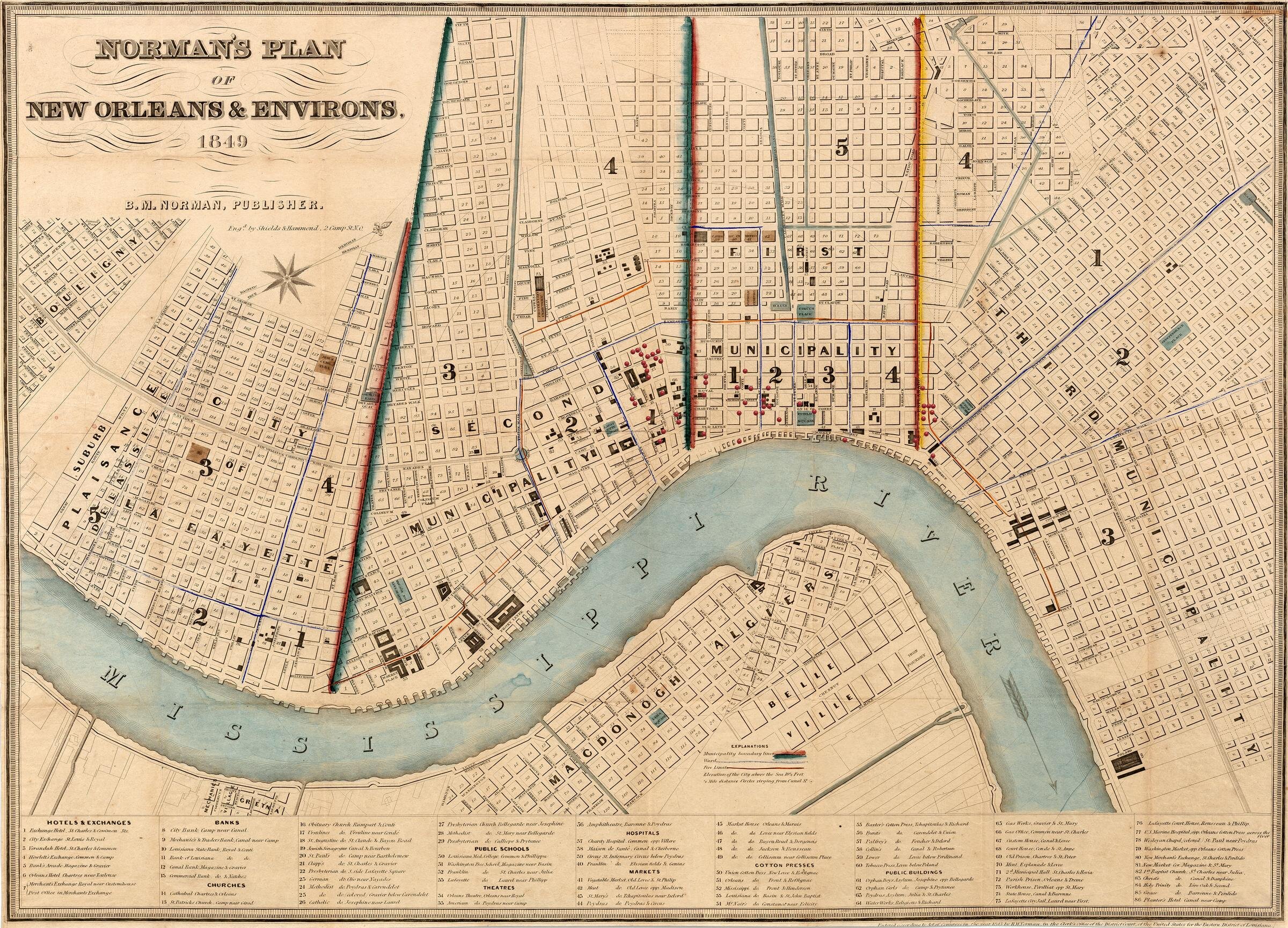
Image: Mapping the Sites of the Slave Trade in New Orleans; resource curated by Erin Greenwald, et. al. for the exhibit Purchased Lives: New Orleans and the Domestic Slave Trade for the Historic New Orleans Collection via Tripod New Orleans
Header Image: Perfect Gentlemen Secondline, 2015, 📸: Jessica Marie Johnson

Digital portals into the history of Africans and people of African descent in Gulf Coast Louisiana
Project Sponsors




The National Historical Publications and Records Commission (NHPRC), a statutory body affiliated with the National Archives and Records Administration (NARA), supports a wide range of activities to preserve, publish, and encourage the use of documentary sources, created in every medium ranging from quill pen to computer, relating to the history of the United States.
Quote Source


